




January 23 - March 7. 2026
The hidden gardens
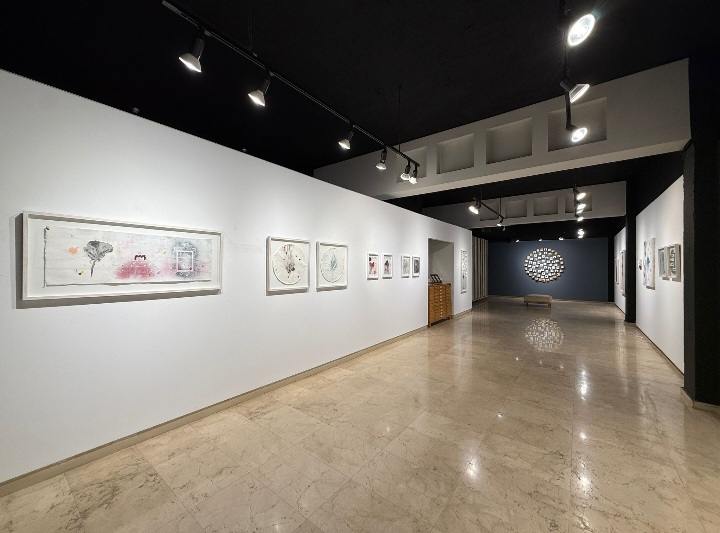
The hiddens gardens.
THE HIDDEN GARDENS
With this broad title of forms and contents, this exhibition proposal is encompassed, consisting of more than 125 works, some of which are part of the installation "Magnolia" (of 71 wooden blocks) or "Garden I" (33 elements with iconographic representations of flowers). The discourse is completed by 19 works on paper and 6 on canvas.
Byung-Chul Han, in his "Praise of Inactivity. Contemplative Life" refers to the duality of the human being and nature in a commitment to romanticism. Referring to the "Hyperion" of the poet and philosopher Hölderlin, he points out that it is important "to end the eternal combat between ourselves and the world, to return the peace of all peace that surpasses all reason, and to unite with nature in an infinite whole".
"Hidden Gardens" proposes a dialogue in and with nature, not as an aesthetic enjoyment, which also has a place there, but as a constant reflection in its gaze, seeking this nature/human union in this infinite whole: "Give me circles", for example, dialogues between a flower and the riverbanks that fall into the water and the expansion of its waves...collecting the moment in which events happen and remain engraved in memory. The work refers to the lack of memory or loss of it: "I feel that memories are diluting" where elements such as the frame, the flower or the castle are diluted in the support. "Dualities for the same body" delves into the roots, the origins of form and being. Each of the works is part of a micro and macrocosm where they can be interpreted as singularity, polarity or a universal questioning...interrogate iconology and iconography so that it serves us for reflection and learning.
"But the most important thing of all that Joanpere Massana carries out is to raise the question and admire the operative simultaneity between the aesthetics of the pictorial experience and the temporal succession of the literary, and to resolve the dilemma so that one contribution does not enter the memory without the other contribution". Arnau Puig Art critic and philosopher.
" Massana has superimposed a more dreamlike and fabulous search of his own, focused on narration and on putting man at the center of thought. He uses metaphor to speak a plain, regular language, whose episodes - between papers and boards there is a clear coherence and a precise thematic development - ??form a single body. Luca Beatrice. Art critic.
The installation " Magnoli ", proposes a vision of the different elements that make up the tree: its support (the wood, which is allowed to breathe outside the work), the flowers with an exquisite and very ephemeral perfume at the same time, the cones that remain of these as mute testimony of what they had been, and the containers with balls where primary colors evoke the possibilities of being. The same composition, the circle evokes the tree itself, the annual rings, the earth.
" Jardí I " questions each flower in an attitude, in a state of mind. A constant metaphor that evokes the fragility of existence and the permanence or not of each moment. Works made with graphite and varnish that let the wood on which they are supported breathe. The search for a precise, archetypal and primitive moment at the same time.
" Massana's painting develops generous gestures and signs that transcend into an emotional abstractism clearly derived from the Informel tradition. On the other hand, the narrative aspect of Massana's reballo links him to the original Transvanguardia of the Campania that develops an imaginary between myth and fantasy, often referring to primary interests, such as space, time and history ". Julia Draganovic. Director of the PAN (Palazzo delle Arti Napoli)
" One could speak in detail about the interpretation of Massana's alphabet and, in fact, an analysis has been carried out in previous critical texts. In any case, I think it is preferable to let the viewer solve the enigma, knowing full well that a unanimous version will never be obtained. Massana's works work precisely by giving up an anecdotal reading and leaving the code of his writing of signs well protected in the artist's mind. " Stefano Castelli. Art critic.
" The hidden gardens " are hidden, and therefore it is necessary for each one to discover them and discover themselves with them. Behind every flower, pebble, staircase, house, there are many elements that dialogue in their and our Being. Far away... in dreams, there are hidden reflections, writings, stripes, spikes, colors, scribbles that seek concretions... you only have to close your eyes after having observed, to then open and savor the chromanisms of the soul.
" The original self, the man capable of expressing himself without forcing, without taking anything for granted, without giving up on allusions. The works of Massana, a kind of grade zero of painting, should not be appreciated, decoded, described, but should only be decanted ". Maurizio Sciaccaluga. Art critic.
 RELATED LINKS
 - Aquins Art Gallery (link)